
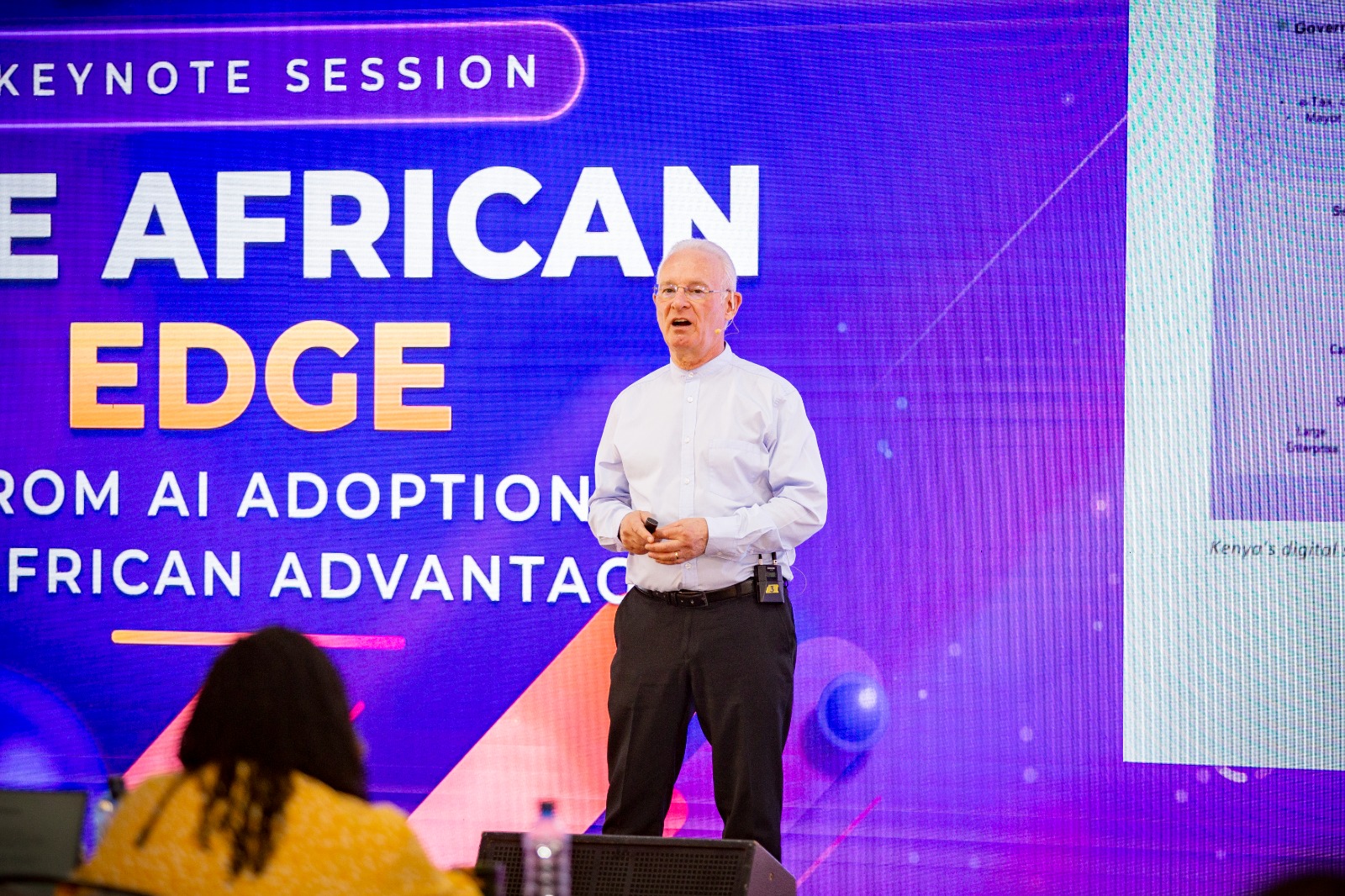
African enterprises must stop merely consuming imported artificial intelligence and start leveraging homegrown solutions to build a global competitive edge, leading technology analysts have urged.
Addressing more than 400 chief information officers and technology executives at the opening of the CIO100 Symposium and Awards 2026 in Diani on Wednesday, World Wide Worx CEO Arthur Goldstuck argued that the continent’s history of innovating under resource constraints is its strongest asset.
Pointing to the global influence of Kenya’s mobile money platform M-Pesa, Goldstuck noted that local challenges often breed world-class innovations. He identified agricultural technology and local-language AI as prime sectors where African firms can lead rather than follow.
“On this continent we face constraints and challenges,” Goldstuck said during his keynote presentation, The African Edge: From AI Adoption to African Advantage. “And we use technology within those constraints to address those challenges.”
Despite rapid uptake across corporate Africa, Goldstuck cautioned that buying advanced software does not guarantee a return on investment. Citing findings from the South African AI Index 2026, he revealed a stark disconnect between adoption and value: while 96 percent of surveyed companies are using generative AI, only 51 per cent report measurable productivity gains. Bridging this gap requires corporate leaders to focus on organisational culture and institutional trust rather than technical deployment alone.
“The real secret of that victory was trust. It wasn’t tech, it was trust,” Goldstuck told delegates, emphasising that confidence in AI systems must be built from the outset.
Furthermore, as generative AI makes it easier to forge identities, documents, and media, Goldstuck warned executives that digital security can no longer be an afterthought.
“Verification becomes part of your product,” he said.
Looking ahead, Goldstuck highlighted the governance risks posed by “agentic AI”—autonomous systems capable of executing tasks independently rather than simply offering recommendations.
“Until now, AI advised and investors decided,” he noted. “But agentic AI acts for itself, and you have to decide who authorised its action.
“To mitigate operational and financial risks, he urged technology leaders to ensure that every automated action is traceable, explainable, and reversible in real time, insisting that human judgement must remain central to corporate decision-making.
Earlier in the session, Harry Hare, Chairman and Co-Founder of CIO Africa by dx5, challenged technology executives to rethink their career trajectories as digital infrastructure becomes the backbone of modern enterprise.
With Chief Information Officers increasingly tasked with managing cybersecurity, talent, capital expenditure, and core business strategy, Hare argued that they possess a uniquely holistic view of corporate operations.
“Businesses are run on systems. And who runs the system?” Hare asked, pointing to a growing trend of Kenyan IT leaders ascending to top corporate roles.
“Should I be planning my exit from the CIO into CEO? Just a thought.”
The three-day symposium, held at Diamonds Leisure Beach and Golf Resort under the theme Innovation at Scale: Driving Business Growth Through IT Leadership, features delegates from over 10 African nations. Sessions span key economic sectors including banking, telecommunications, healthcare, and manufacturing, culminating on Friday with the annual CIO of the Year Gala Awards Dinner.