
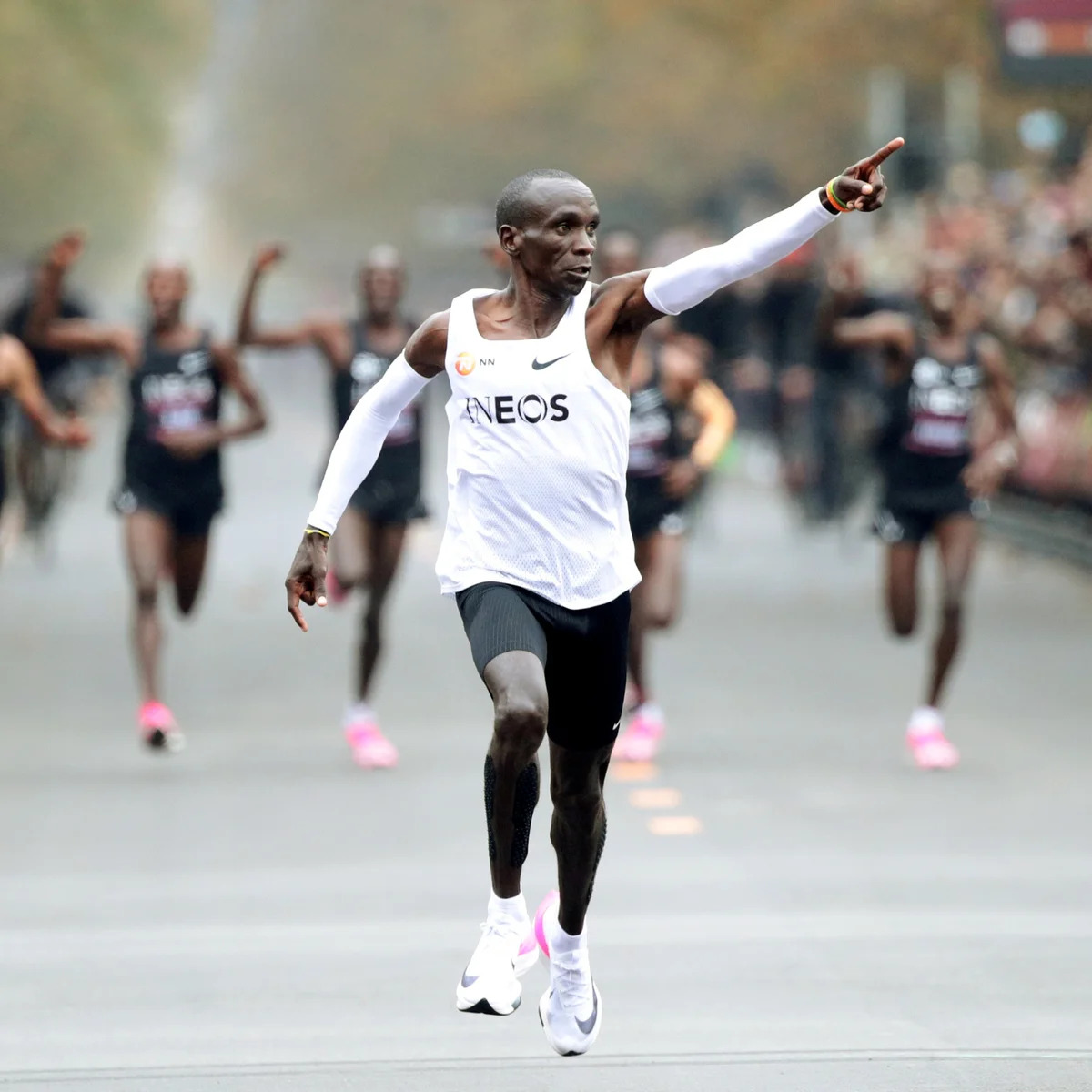
At 41 years old—an age when most long-distance runners have long hung up their racing flats—two-time Olympic champion Eliud Kipchoge is actively rewriting the script of athletic longevity. Now entering his 24th year of professional competition, the legendary Kenyan marathoner continues to prove that age is merely a statistic.
His latest triumph took him to Australia, where he conquered the streets of Melbourne with a course-record victory of 2:09:10, finishing at the historic Melbourne Cricket Ground (MCG). For Kipchoge, this victory carried deep historical resonance, echoing the spirit of the 1956 Melbourne Olympics. “A 17-year-old named John Ian Wing told the people of Melbourne ‘let us walk together’ during the 1956 closing ceremony,” Kipchoge reflected during a partnership launch in Nairobi. “Seven decades later, I told the people there exactly the same thing. It was a real feeling.”
The Australian victory marks a crucial leg in Kipchoge’s broader expedition: a global tour spanning all seven continents. Unlike his past years spent chasing world records in Berlin or Olympic golds in Rio and Tokyo, this world tour demands a different kind of sacrifice—balancing heavy community outreach, running clinics, and media engagements with elite-level training.
This pioneering mindset is nothing new for Kipchoge, who famously electrified the sports world seven years ago by becoming the first person to break the two-hour marathon barrier with a historic 1:59:40 in Vienna. When younger athletes Sabastian Sawe and Yomif Kejelcha recently achieved sub-two-hour marathons in a competitive London race, Kipchoge expressed genuine pride rather than envy, celebrating the evolution of the sport he helped shape.
Now, that same ethos is driving him toward his most extreme venture yet: running a marathon on the icy terrain of Antarctica. Facing sub-zero temperatures and frozen landscapes, Kipchoge aims to prove that mental fortitude can triumph over any environment—and perhaps even spark research into adding long-distance running to the Winter Olympics. As he prepares for the extreme polar cold, Eliud Kipchoge’s message remains as simple as it is profound: No human is limited.